

The hidden cost of heavy access covers
Across council, education, and urban infrastructure environments, access covers are a critical but often overlooked asset. Traditional asphalt and metal pit lids have long been the default solution for drainage and service access. However, their weight, degradation over time, and maintenance demands introduce significant occupational health and safety (OH&S) risks, operational delays, and avoidable lifecycle costs.
In high-traffic and pedestrian-priority areas, these risks are amplified. Distorted lids can quickly become trip hazards, while heavy lifting requirements expose maintenance crews to manual handling injuries and force reliance on mechanical lifting equipment.
OH&S challenges with traditional heavy lids
Conventional metal and asphalt lids typically present three recurring issues:
- Manual handling risk: Excessive lid weight increases the likelihood of musculoskeletal injuries during routine inspections and drain cleaning.
- Dependence on lifting equipment: Cranes or mechanical aids are often required, adding setup time, additional personnel, and safety controls.
- Progressive surface deformation: Under repeated vehicle impact, traditional lids can warp or settle, creating uneven surfaces and public safety hazards.
These issues not only compromise worker and public safety but also slow down essential maintenance activities, increasing costs over the asset’s life.
Performance demands in D-Class load environments
D-Class rated areas, such as school crossing zones, access roads, and service corridors, require access covers that can withstand high loads and incidental vehicle traffic without compromising surface integrity.
Key performance requirements include:
- Compliance with D-Class load ratings
- Structural stability under dynamic vehicle loads
- Secure, lockable design to prevent unauthorised access
- Durability in outdoor and high-use environments
Balancing these requirements with safe manual handling is where many traditional solutions fall short.
The FRP alternative: lightweight without compromise
Fibre Reinforced Polymer (FRP) access covers offer a fundamentally different approach. Engineered for strength, not mass, FRP trench covers deliver high load performance while remaining light enough for manual handling.
Key advantages include:
- Significantly reduced weight compared to steel or concrete alternatives
- High-strength construction engineered to meet D-Class load requirements
- Lockable systems to enhance site security and safety
- Corrosion and impact resistance for long-term durability
- Low maintenance over the asset lifecycle
By removing the need for mechanical lifting aids, FRP access covers enable faster, safer, and more efficient maintenance operations.
Project: Lowther Hall – D-Class pit lids
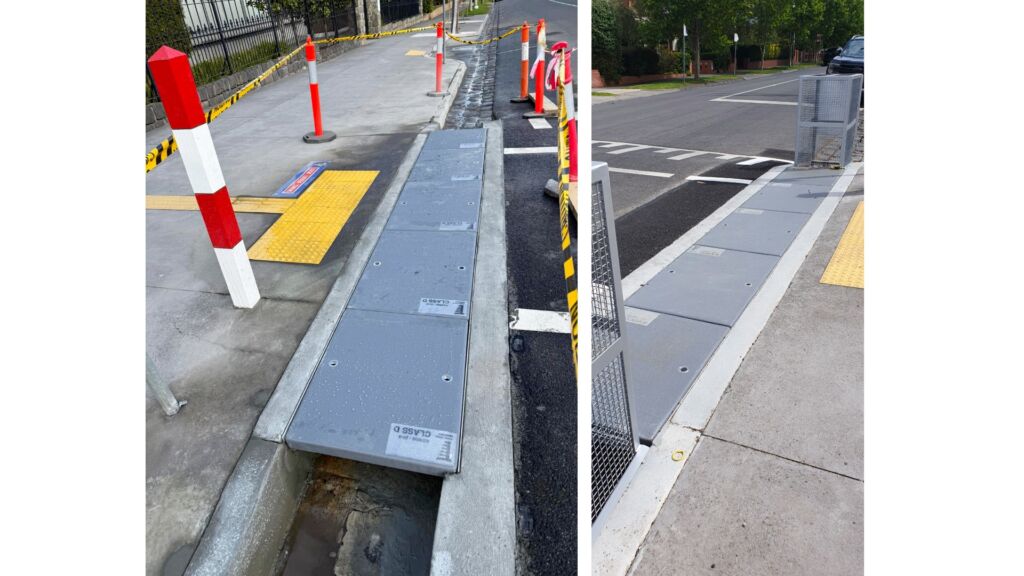
In a busy school crossing zone at Lowther Hall, within Moonee Valley City Council, routine drainage access had become a growing safety and maintenance concern. Existing asphalt and metal pit lids were repeatedly impacted by vehicles, causing distortion and uneven surfaces in a high-pedestrian environment. What began as a maintenance issue increasingly presented a public trip hazard.
For maintenance crews, the problem extended below the surface. The heavy lids were difficult to remove during routine drain cleaning, requiring mechanical lifting equipment and additional setup time. This introduced avoidable OH&S risks, delayed maintenance activities, and increased the cost of what should have been a straightforward task.
To address these challenges, Terra Firma supplied D240 heavy-duty, lockable FRP trench covers, engineered to meet D-Class load requirements while remaining lightweight enough for safe manual handling. The result was a safer, faster, and more efficient maintenance process, improved surface integrity in a critical pedestrian area, and a durable, low-maintenance asset solution designed to perform over the long term.
Tangible ROI: safety, time, and cost savings
While the upfront cost of access covers is often a focus, the real return on investment is realised through reduced operational risk and ongoing efficiency gains.
Lightweight FRP access covers contribute to measurable ROI by:
- Reducing labour time per maintenance task
- Minimising the need for lifting equipment and traffic management
- Lowering injury risk and associated compliance costs
- Extending replacement cycles through durable materials
For councils and asset owners, this translates into safer worksites, fewer disruptions, and lower whole-of-life costs.
Designing out risk through smarter infrastructure
Access covers may be small components within larger infrastructure systems, but their impact on safety and maintenance efficiency is substantial.
By specifying lightweight, high-strength FRP access covers in D-Class load-rated locations, asset owners can proactively eliminate maintenance risks, improve public safety outcomes, and achieve stronger lifecycle value.
Learn more about Terra Firma’s pit lids and access cover solutions.
Share this
Discover the Terra
Firma difference
Learn how we can help support your next project