

Specifying grating and access structures for a water or wastewater treatment facility is a decision with long consequences. In water and wastewater treatment environments, grating and access structure materials are exposed to constant moisture, hydrogen sulphide gas, and aggressive chemical dosing. The material selected at the design stage directly influences maintenance frequency, operational safety, and asset lifespan for decades afterward — yet steel remains the default specification on many projects.
What Makes Water and Wastewater Treatment Environments Different
The operating environment inside a water or wastewater treatment plant is categorically more aggressive than most industrial settings. Hydrogen sulphide gas, generated as a byproduct of biological treatment processes, attacks protective coatings and underlying substrates in enclosed spaces — often before surface deterioration is visible. Constant splash, spray, and saturation create sustained moisture exposure across walkways, platforms, and grating throughout the facility. Chemical dosing inputs — chlorine, ferric sulphate, lime — introduce additional chemical load through spills, aerosols, and routine wash-down.
The material implications of this combination are covered in detail in Terra Firma’s blog on FRP chemical resistance and resin selection. What that piece doesn’t address is what these conditions mean specifically for grating and access structure specification — which is where this post focuses.
How FRP Grating Addresses Corrosion and Safety Challenges
Fibre-reinforced polymer composites approach the corrosion problem differently. Rather than protecting a susceptible substrate with a surface coating, FRP composites are engineered for high resistance to chemical and corrosive environments. The resin matrix is inherently resistant to the chemical, moisture, and biological conditions present in treatment environments.
For grating specifically, Terra Firma’s moulded grating provides P5-rated slip resistance as an integral surface property. In facilities where wet, chemical-exposed walking surfaces are a daily operational reality, that slip resistance performance can be maintained across the service life with minimal remediation. FRP panels are also substantially lighter than steel equivalents, which directly reduces manual handling risk for maintenance staff accessing grating throughout the operational life of the facility.
High-Risk Zones for FRP Grating in Water Treatment Plants
Several areas within a treatment facility consistently create the conditions where FRP specification delivers clear advantages:
Pump stations and wet wells: enclosed, poorly ventilated, and subject to sustained H₂S exposure and constant moisture.
Clarifier surrounds and tank edges: continuous splash and process water contact, often with residual chemical load from dosing operations.
Chemical dosing areas: direct chemical exposure from spills, aerosols, and wash-down on a routine basis.
Control room and pump station flooring: wet, chemically active environments where structural performance and slip resistance both matter.
Colac Water Reclamation and Treatment Plant
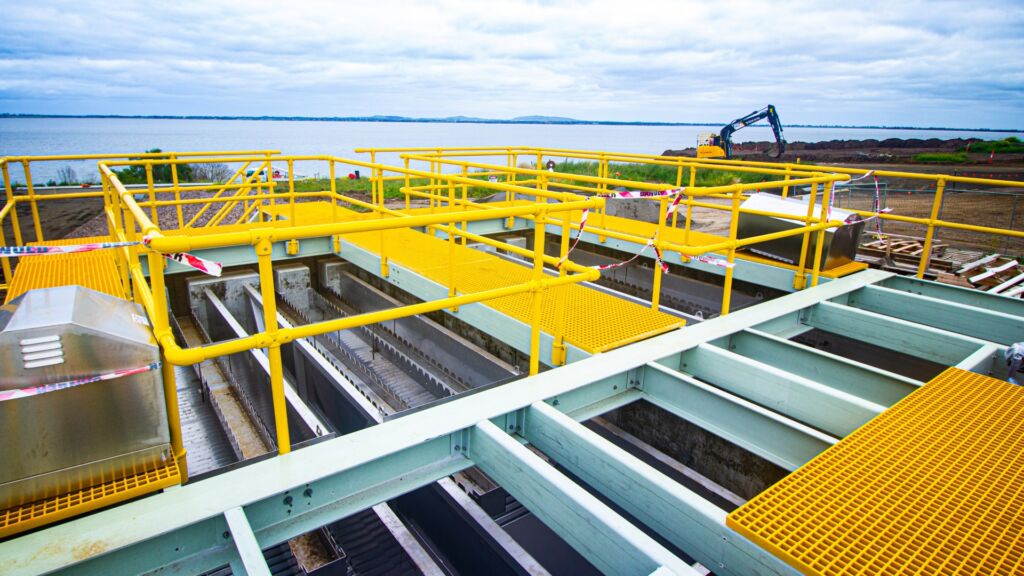
The Colac Water Reclamation and Treatment Plant demonstrates what FRP specification in a treatment facility looks like in practice. The project involved a complex structural configuration in a corrosive, high-risk work environment. Terra Firma manufactured and pre-assembled FRP grating, handrails, and structural profiles off-site before shipping the system semi-assembled for efficient on-site installation — minimising time in a high-risk environment while delivering integral P5 slip resistance and full chemical resistance across all structural elements.
It’s a useful reference point for what early design-stage engagement with a composite supplier makes possible, and what the installed outcome looks like across a real treatment facility.
What a Sound FRP Grating Specification Looks Like
For engineers and asset managers working on treatment plant infrastructure, a well-formed FRP grating specification should address:
Resin system matched to the chemical environment. Vinyl ester resin is the appropriate baseline for water and wastewater treatment applications. Specifying the resin type — rather than leaving it to supplier discretion — ensures the product is rated for actual site conditions.
Slip resistance as an integral characteristic. P5 for wet operational environments, specified as a built-in surface property rather than a surface-applied treatment.
Grating type matched to the application zone. Moulded grating for most access applications; micro mesh or solid top where liquid containment or finer aperture is required; pultruded grating where longer spans and higher structural loads apply.
Load rating defined before product selection. Foot traffic, equipment access, and operational loads should be resolved at the specification stage, not during procurement.
Prefabrication scope discussed early. For complex or confined configurations, off-site prefabrication reduces on-site time and exposure in high-risk environments — a conversation worth having during design development.
Engaging a composite supplier at the design stage — before drawings are issued and procurement is underway — allows these criteria to be resolved in the right sequence.
Talk to Terra Firma
Terra Firma works with engineers and asset managers at the design stage to develop FRP grating and access structure solutions for water and wastewater treatment applications. Contact our team to discuss specification support, material selection, or prefabricated FRP solutions for your next project.
Share this
Discover the Terra
Firma difference
Learn how we can help support your next project