

If you manage capital works for parks, trails, or public access projects, you’ve probably lived through this scenario: a boardwalk or walkway goes out to tender, the timber quote looks familiar and manageable, and then reality sets in. A few years later you’re back in the same reserve, budgeting for repairs, chasing a contractor for a maintenance fix, or explaining why a structure that’s barely out of its warranty is already showing rot, splitting, or fire damage, not because anyone did anything wrong, but because timber, steel, and treated pine were never really built for what our parks and reserves throw at them: harsh UV, damp ground, bushfire risk, and constant foot traffic in locations that are hard to reach for repairs.
For asset managers and project engineers who aren’t materials specialists (and don’t need to be), this article is a practical starting point: what to ask when you’re specifying a composite boardwalk, ramp, or outdoor access structure, what actually matters in a public setting, and why more councils and parks authorities are moving toward prefabricated walkways to reduce risk across the life of the project.
The Questions Worth Asking Before You Specify
Good specification starts with asking the right questions early, before a material or supplier is locked in. A few worth putting to any supplier or design team:
How will this structure perform in full sun, over years, not months? UV degradation is one of the most common (and most avoidable) causes of premature ageing in outdoor structures.
What happens in a bushfire-prone area? If your site sits within a bushfire attack level (BAL) zone, ask whether the proposed material and structure has been designed with that in mind, rather than treated as an afterthought.
How will it handle moisture, ground contact, and drainage? Structures near waterways, wetlands, or low-lying reserves are exposed to conditions that accelerate decay in traditional materials.
What’s the real load requirement? Public access structures need to safely account for pedestrian traffic, maintenance vehicles, and in some cases emergency access, not just an average-use estimate.
Does the structure need to meet DDA compliant ramp requirements? Disability access is a core design input for most public walkways, not an add-on, worth confirming early with your design or engineering team.
Who is actually responsible for maintenance once it’s installed? If the honest answer is “whoever’s on the parks team that year,” that’s a strong argument for a lower-maintenance material from the outset.
Asking these questions doesn’t just protect the asset, it protects your budget and your program timeline, because it’s far cheaper to get the material decision right at the design stage than to fix it after installation.
Why Material Choice Is a Program Risk, Not Just a Technical One
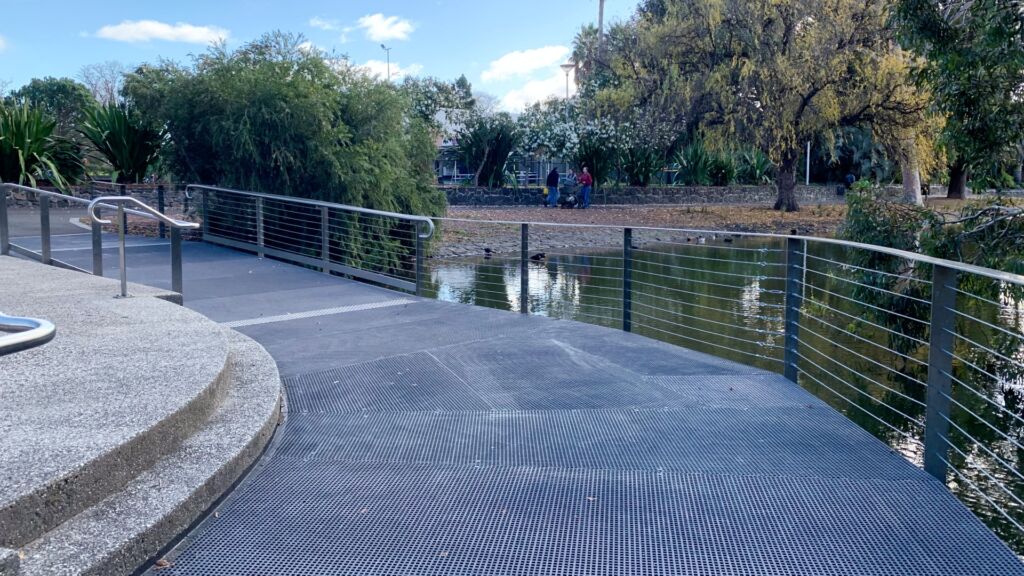
Material selection is often treated as a technical detail for engineers or specifiers to sort out separately from program delivery. In practice, the two are closely linked, a structure that needs early repairs or replacement doesn’t just cost money, it disrupts community access, creates safety exposure, and eats into capital works budgets meant for the next project, not fixing the last one.
This is where FRP boardwalks and other composite structures have become a practical option for parks, trails, and public reserve projects. They still require some upkeep over their life, like any public asset, but they’re engineered to hold up to UV exposure, moisture, and bushfire-prone conditions, without the same level of ongoing treatment, repainting, and structural repair that timber and steel typically demand. They can also be manufactured as prefabricated walkways, built off-site to the project’s specifications and delivered ready to install, which matters just as much to a project team managing multiple sites or tight construction windows as the material properties do, since it reduces what can go wrong on site and how much public access gets disrupted during construction.
None of this is about replacing good design or engineering judgement, it’s about making sure the material decision holds up under the conditions your site will actually face, not just the conditions on the spec sheet. If you’re early in the design phase and want a second opinion before you lock in a specification, that’s exactly the kind of conversation worth having before tender, not after.
Why Design-to-Delivery Support Matters
One of the biggest program risks in public access projects isn’t the material itself, it’s the hand-off points. A design gets specified by one party, quoted by another, and installed by a third, and every hand-off is a chance for something to be misread, under-scoped, or delayed. Terra Firma works with council and parks project teams from the design consultation and site inspection stage through to prefabrication and delivery of the finished structure, so the same team that helped shape the specification is accountable for what turns up on site, a continuity that reduces the risk of surprises later in a capital works program juggling multiple sites and stakeholders.
Get in Touch
Planning a boardwalk, ramp, or public access structure and want to talk through your site’s specific requirements? Our team offers design consultations and site inspections plus manufacture and install services to help parks and council project teams specify with confidence.
Contact the Terra Firma team to start the conversation.
Share this
Discover the Terra
Firma difference
Learn how we can help support your next project