

Ageing industrial infrastructure in high-traffic environments is under increasing regulatory pressure to upgrade. Traditional materials like steel and aluminium are falling out of favour due to OH&S concerns and high production and maintenance costs.
That’s why many teams are turning to fibre-reinforced polymer (FRP) for access structures, walkways and handrails – infrastructure solutions that need to perform reliably under load, frequent use, and environmental exposure.
But before looking at how FRP addresses these issues, it’s important to understand the safety and compliance challenges that traditional materials face in high traffic areas and chemically exposed environments.
The challenge of maintaining safe infrastructure solutions
Industrial environments are demanding. Combined chemical exposure, moisture and heavy foot traffic accelerate the deterioration of traditional materials like steel, creating safety risks that are difficult and costly to manage. Common challenges include:
- Corrosion: Steel degrades rapidly in wet, chemically aggressive, or coastal environments, compromising its structural integrity over time
- Slip and fall hazards: Worn or corroded surfaces increase the risk of serious injuries – particularly on stairs, platforms and elevated FRP walkways
- High maintenance costs: Traditional materials require regular inspection, treatment and replacement, driving up both direct costs and operational downtime
Regulatory frameworks are responding to these risks, raising the bar for worker safety solutions across industrial environments. OH&S managers need to be across the key standards now driving infrastructure decisions.
Food Safety Standards (updated 2023)
- Standard 3.2.2 covers hygiene and cleaning/sanitising
- Standard 3.2.3 requires premises, fittings, and equipment to be designed for easy cleaning and sanitation
Both create direct requirements for the type of surface performance FRP delivers.
Model WHS Regulations 2025 (published by Safe Work Australia, December 2025)
- Mandates hazard identification, assessment and control, and strengthens duty of care obligations for employers. (Note: Victoria is the only state that has not already adopted the new Regulations.)
For OH&S managers, the direction of travel is clear – the regulatory bar is rising, and infrastructure that can’t meet it is becoming a liability.
FRP, the compliance-ready solution
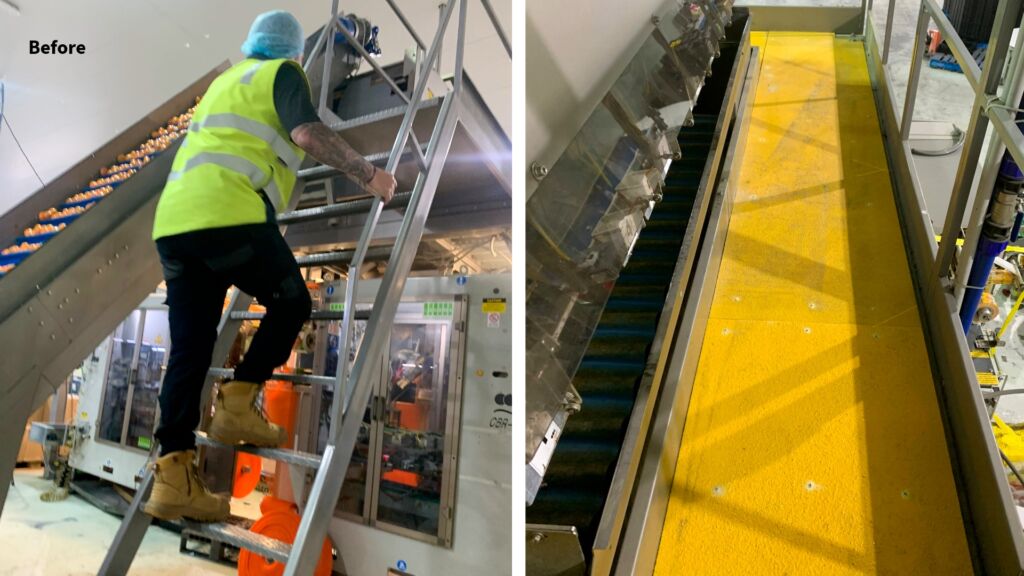
Where steel requires off-site fabrication to precise dimensions (and expensive, time-consuming rework if something doesn’t fit), FRP can be modified on-site with standard hand tools. That flexibility makes it particularly well-suited to retrofit projects, where existing structures rarely conform to ideal specifications.
Beyond installation, FRP’s material properties address the core compliance and safety requirements head-on:
- Built-in P5 slip resistance: The highest slip resistance rating available, engineered directly into the surface
- Chemical resistance: Compatible with a wide range of industrial and food-grade cleaning agents
- High-visibility options: High-vis stair nosing, handrails and platforms are ideal worker safety solutions for busy or low-light environments
- Fire resistance: FRP industrial grating carries a BAL40 fire-resistant surface rating, an important consideration in environments with strict safety standards
- Reduced maintenance: Unlike steel, FRP doesn’t rust or corrode, significantly lowering the long-term cost of maintaining compliant infrastructure
- Load-rated options: FRP walkways and platforms can be engineered to meet required load ratings for human traffic and light equipment.
Terra Firma’s full range of FRP infrastructure solutions for industrial access structures includes non-slip stairs, platforms, handrails, step-overs, non-slip ramps, anti-slip flooring and high-vis stair nosing.
FRP in practice: industrial environments
The case for FRP becomes clearest when you look at how it performs across the environments where traditional materials consistently fall short.
At one food processing facility we worked with, workers needed to access elevated equipment, including hoppers, pumps and processing machinery, in an environment subject to frequent chemical wash-downs. FRP access structures replaced deteriorating steel structures, maintaining slip resistance in wet conditions and withstanding aggressive sanitising cycles that steel couldn’t sustain.
For a dairy operation, the demands were similar. Transitioning to a robotic milking system required safe, durable access to elevated feed systems in an environment where harsh alkali and acid-based cleaners are routine. FRP industrial grating provided compliant slip resistance and chemical durability that steel couldn’t match long-term.
Meeting compliance with confidence
Getting infrastructure solutions right in industrial environments isn’t just about specifying the right material. It’s about having the right conversations early, with all the parties involved. OH&S managers, facilities teams and contractors each have a stake in how access structures are designed, installed and maintained, and aligning those requirements from the outset reduces both risk and rework.
At Terra Firma, we work with teams across industrial, food processing, agricultural, and high-footfall environments to develop access solutions that meet compliance requirements without overcomplicating projects. With in-house Australian-based design, construction and FRP infrastructure specialised installation partners, we can support every stage from specification and design through to project completion.
If your access infrastructure is due for review, contact us today for expert guidance tailored to your project’s requirements.
Share this
Discover the Terra
Firma difference
Learn how we can help support your next project